

This might be one of the most important XR devices that I have reviewed in years.
And no, this is not another huge, heavy VR headset.
These are the UR XR One, a completely new kind of spatial computing glasses.
They are almost as small and lightweight as normal video glasses from XREAL or VITURE. You connect them to your computer, phone or handheld through USB-C, just like those devices.
But inside, they have technology that reminds me much more of something like the Apple Vision Pro.
We are talking about pancake lenses, high-resolution microOLED displays, full-color video passthrough, 6DOF tracking and even hand tracking.
And all of that fits into glasses that weigh only 93 grams.
That is pretty incredible.
But what makes the UR XR One especially interesting to me is that they are primarily designed for productivity.
I already use devices like the XREAL One Pro for getting work done. I love being able to connect lightweight glasses to my computer and work on a huge virtual screen.
But those devices have always come with one major compromise: the field of view.
The UR XR One fixes that.
They offer a 90-degree diagonal field of view. For comparison, even the upcoming XREAL Aura is supposed to only offer around 70 degrees.
And the UR XR One does not only give you one bigger virtual screen. When connected to a compatible device, you can create several virtual screens, position them anywhere around you, resize them and use them almost like the spatial windows of the Apple Vision Pro.
Only here, you get them in a form factor that makes so much more sense for working.
And yes, you can also connect the glasses to a Steam Deck, ROG Ally, Switch 2 or other gaming devices.
Games look absolutely fantastic on these microOLED panels.
So how much does all of this cost?
The Kickstarter price is 799 US dollars, and the normal retail price is supposed to be $899 after the campaign.
Let me tell you directly at the beginning of this review: in my opinion, this is a no-brainer.
I have reviewed a lot of headsets over the years. Pretty much all of them.
And I believe this might be one of the most important XR devices that I have seen in a very long time.
Let me tell you why.
Design and Build Quality
The design of the UR XR One might look familiar to some of you.
That is because this reminds us of other headsets we have seen that are based on the Gravity XR chip.
I recently made a video about it. It is a specialised chipset designed to bring proper spatial computing functions to lightweight devices and even though the company did not disclose what actually makes the hardware tick, chances are very good this is powered by Gravity XR as well.
And I think this is exactly the kind of product where this technology makes sense.
The UR XR One is not trying to replace your computer. Instead, it gives the computer that you already use huge virtual displays and spatial computing functionality.
You can connect it to a MacBook, a Windows laptop or desktop PC and continue using all the software that you already depend on.
The glasses themselves weigh only 93 grams.
For the displays, we are getting two 1.03-inch microOLED panels, with a resolution of 2448 by 2064 pixels per eye.
That is considerably higher than the Full HD class displays that we normally find in video glasses.
It brings the resolution much closer to dedicated VR headsets like the Bigscreen Beyond 2.
The company states a center sharpness of 36 pixels per degree, and you get the full display resolution at 90 hertz.
The optical system uses pancake lenses, just like modern VR headsets.
And unlike most video glasses, the URXR One offers real mechanical IPD adjustment for each eye.
The supported IPD range is between 58 and 68 millimeters.
That is a big advantage because it allows you to properly align both lenses with your eyes instead of relying on a fixed optical design.
The glasses connect through USB-C using DisplayPort Alt Mode.
Compatible source devices include laptops, desktop PCs with USB-C video output, phones, Steam Deck, ROG Ally and other handheld gaming devices.
Because these high-resolution microOLED displays produce heat, the glasses have active cooling built into them.
That is necessary for this kind of display technology.
The built in fan does produce noise, but it only hums away consistently and never annoyed me. Check out my full video review to listen to it yourself. But without a doubt, the standard video glasses that do not need a fan at all have an advantage here because there is no noise at all.
And just like those standard video glasses, the UR XR One does not have a large battery built into the headset. It receives power directly from the connected device.
On the front, we have two SLAM cameras for positional tracking, two cameras for color video passthrough, an LED and an ambient light sensor.
That ambient light sensor is important because it helps the headset match the colors and brightness of the passthrough image to your real environment.
This makes the transition between the video passthrough in front of you and the real world in your peripheral vision feel much more seamless.
And in my experience, this works really well.
The glasses do not come with several different nose pads. However, the installed nose pad is much larger and more comfortable than what we normally get with video glasses.
You can also bend and adjust it to fit your nose, so most people should be able to find a comfortable position.
Overall, the hardware feels extremely polished.
This does not feel like an experimental prototype. It feels like a finished consumer product. And we do not see this level of polish so early in a product’s life cycle very often in this industry.
Visual Quality
The first time you put on the UR XR One, you will immediately notice the difference to your standard video glasses.
I really like my XREAL and VITURE headsets, but their limited field of view has always been a compromise.
When you are working on a virtual display, parts of the screen can get clipped as you move your head.
You are constantly aware that you are looking through a relatively small window.
On the UR XR One, that problem is mostly gone.
The field of view is not yet as large as a full-sized VR headset, but it is finally large enough that I can work comfortably without constantly seeing the edges of my virtual screens getting cut off.
You also get a noticeable sharpness improvement over standard Full HD video glasses.
The URXR One offers a panel resolution of 2448 by 2064 per eye and receives a signal input of up to 2560 by 1440 at 90hz from connected devices.
That is simply better than the approximately 1920 by 1200 resolution that we currently get from most XREAL and VITURE glasses.
The image is visibly sharper. Individual pixels are harder to see, text looks cleaner and there is less shimmering around small letters and fine details, something that is very visible in the current gen video glasses.
That makes a real difference when you are reading websites, editing documents or getting any kind of serious work done. I have been working with the XREAL One Pro connected to my MacBook Air on a daily basis for more than a year now. I could work comfortably with this setup, but sometimes I did wish for a resolution bump. And here we got it!
It is not a day and night difference, because the higher resolution is also spread over a bigger FOV, but again, you do not get this shimmer around text and overall, it is simply cleaner and easier to work with. On top of that the strange distortion problems that birdbath optics are plagued with are gone here. And yeah, the FOV. We will get to that in a moment.
The colors are exactly what you would expect from good microOLED displays.
You get vibrant colors and proper, deep blacks.
I also did not notice problematic black crush. You can still see details in dark scenes instead of everything disappearing into pure black, which is a problem of some of the competing flagship video glasses.
That is important not only for working but also when watching movies or playing games.
And of course, you can use these glasses as a portable cinema.
You can sit back and watch a movie on a huge virtual display that is noticeably wider than what you get from most competing video glasses.
Brightness is good, although it is not quite as high as some glasses that use birdbath optics.
That is one of the compromises of pancake lenses. Pancake optical systems do not transmit as much light as some other solutions.
But the UR XR One is still bright enough. And do not compare this to the “Nits” values that other companies advertise their headsets with. Those feel quite a bit inflated in most of the cases. The brightness here is totally fine.
It never felt uncomfortably dim to me, and you can also see that in my through-the-lens footage.
Lenses
The pancake lenses themselves are very good.
They offer excellent edge-to-edge clarity, which means that the image stays sharp across most of the virtual screen.
That is particularly important for productivity. You do not want to constantly turn your head just to read text at the edge of a monitor.
I also did not notice any major color shifts around the outside of the lenses, which is a problem that we sometimes see with pancake optics.
There is some typical pancake glare.
Every pancake lens produces at least some glare, particularly in high-contrast scenes with bright objects against a dark background.
The UR XR One is no exception.
But the amount of glare is completely acceptable and did not bother me during normal use.
Honestly, I prefer this small amount of pancake glare over the reflections beneath the displays that I could see on devices like the XREAL One Pro and VITURE Beast. If I had to compare the amount of glare to an existing VR headset, I would say it is comparable with that of the Pima Dream Air.
FOV & Binocular Overlap
And now we have to talk about the field of view, because that is the big upgrade.
The company advertises a 90-degree diagonal field of view.
But diagonal numbers are not always the most useful way to understand how large an image actually feels.
The headset has an FOV of 80 degrees horizontally and around 57 degrees vertically.
That gives the visible area a relatively wide, almost 16:9-shaped appearance.
And that works extremely well for virtual monitors because we are already used to working on displays with that kind of aspect ratio.
The horizontal field of view is roughly 30 degrees wider than what we normally get from standard video glasses.
That is not a small improvement!
It completely changes how useful these glasses are for productivity. No more clipped windows, it is noticeably better to get work done with the URXR One.
Binocular overlap is also good at approximately 75 percent.
That helps both eyes see enough of the same image, making it more comfortable to look at virtual displays for longer periods without eye strain. I used them for hours and my eyes felt perfectly fine during and after my sessions.
Passthrough
The color passthrough is truly impressive.
The perceived latency is incredibly low.
If you were impressed by the low-latency passthrough of the Apple Vision Pro, you might be shocked to learn that this tiny device is rated at only 9 milliseconds of passthrough latency.
That is even lower than the Apple Vision Pro. And you can feel it.
When you move your head, the world responds immediately. It does not feel disconnected or delayed.
In terms of resolution, I would compare the passthrough quality to the Quest 3, but without the strange distortion effects that you sometimes notice on the Quest. It can still get noisy in darker environments and increasing the passthrough resolution would be a meaningful upgrade for the URXR Two.
For a device this small, the passthrough is astonishingly good.
It is absolutely usable for working.
Once you start concentrating on your virtual monitors, you can almost forget that the room around you is being shown through cameras.
Thanks to the ambient light sensor, the colors of the passthrough also match your real surroundings surprisingly well.
That helps the camera image in front of you blend naturally into the real world that you can still see around the sides of the glasses.
Unseen Reality has done a very good job here.
Overall, the visual package is stunning for this kind of form factor.
This is what many of us have been waiting for: lightweight glasses with a genuinely larger field of view.
The fact that we are also getting convincing spatial computing functions and excellent color passthrough feels like a massive bonus.
Comfort
Comfort is another big strength.
The URXR One weighs only 93 grams.
Compared with an Apple Vision Pro, Quest 3 or Samsung Galaxy XR, this is a night-and-day difference.
Before trying the device, I was actually skeptical about the glasses form factor.
I thought that with the larger field of view, pancake lenses, cooling system and all the built-in cameras, the device might need a more traditional VR head strap.
I was wrong.
The glasses are so light and so well balanced that I regularly forgot I was wearing them.
That is a far cry from traditional VR headsets, where you constantly feel the pressure on your face, forehead or cheeks.
The large nose pads also help.
They distribute the weight much better than the small nose pads that we normally get with video glasses.
I can comfortably wear the URXR One for several hours.
And just as importantly, the glasses do not completely isolate me from my surroundings.
They are small enough to use in public spaces without attracting the kind of attention you would get while wearing an Apple Vision Pro or another large mixed-reality headset.
I could easily imagine using these on a train, on an airplane, in a hotel or at a co-working space.
Audio and Microphones
Unseen Reality decided not to include built-in speakers.
And honestly, I am completely fine with that.
The speakers built into traditional video glasses have never really convinced me.
I normally end up using my own earbuds anyway.
Leaving out the speakers saves weight, reduces cost and keeps the design simpler.
Since the UR XR One is primarily designed for productivity, you might not even need audio most of the time.
And when you do want to watch a movie, play a game or join a call, you can simply use your preferred earbuds or headphones, since your source device offers an audio solution anyways.
For me, this was the right decision.
Interestingly, the glasses do contain four microphones capable of recording spatial audio.
How the URXR One Works
Using the glasses is very simple.
You connect the USB-C cable to a compatible device with USB-C video output.
That could be a MacBook, Windows laptop, desktop PC, Steam Deck, ROG Ally, iPhone or another compatible device.
At the most basic level, you immediately get a large virtual screen pinned in the space in front of you.
And because of the wider field of view, you can see much more of that display at once compared to normal video glasses.
The exact tracking functionality depends on how much power the USB-C port can supply.
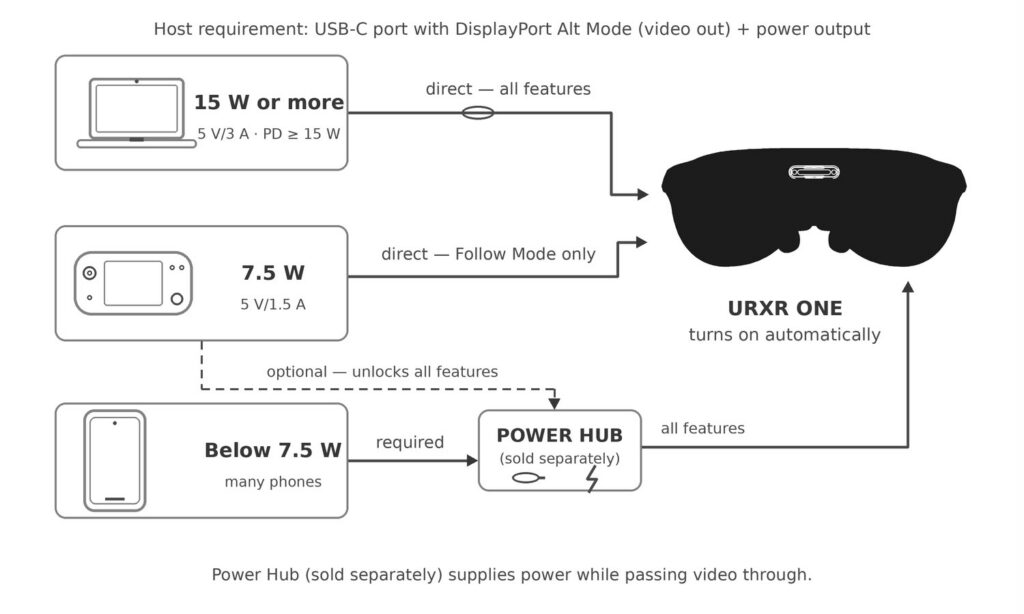
To enable full 6DOF tracking, the glasses need approximately 15 watts of power from the USB-C port.
With 6DOF tracking, you can move your head forward, backward and sideways relative to the virtual displays.
You can physically lean closer to a screen to inspect something or move around the virtual workspace naturally.
Many MacBooks, Windows laptops and desktop PCs with suitable USB-C ports can supply this amount of power.
If the USB-C port supplies around 7.5 watts, the glasses still provide stable 3DOF tracking.
With 3DOF, the virtual screen remains locked in a direction around you, but the system does not track your physical position.
You cannot lean closer to the virtual display in the same way.
Honestly, for many use cases, 3DOF is already good enough.
You still get a large, stable virtual screen with the improved field of view.
Devices like the Steam Deck and ROG Ally will normally operate in this mode.
You can also use the UR XR One with the Nintendo Switch 2.
You will need an inexpensive third-party adapter that costs around 20 dollars, but once connected, it works fine.
Devices that cannot supply at least 7.5 watts require the optional Power Hub.
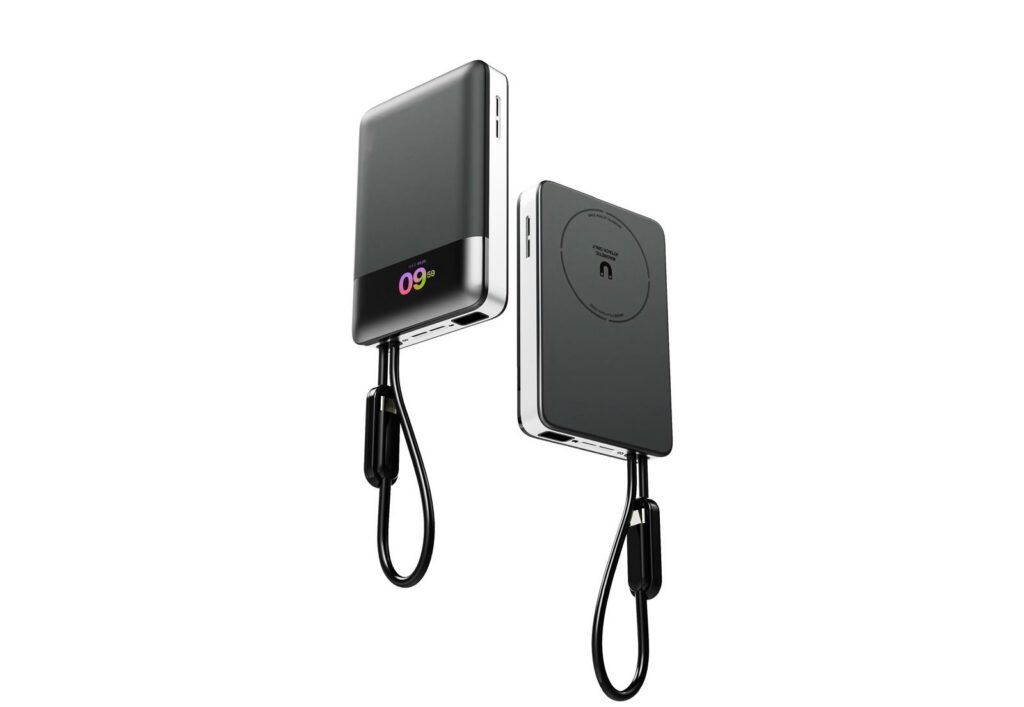
The Power Hub sits between the glasses and the source device and supplies the additional power.
This may be necessary for certain phones that support USB-C video output but do not provide enough power for the headset.
The Power Hub can also push compatible devices up to the full 15-watt operating mode, enabling 6DOF functionality.
Spatial Computing and Multiple Screens
This is where the UR XR One becomes truly special.
When you connect it to a device that can provide 15 watts and runs the URXR companion app, you can create multiple virtual displays.
I tried this on a Windows laptop, and I was genuinely shocked by how good it was.
It gave me something very close to the Apple Vision Pro spatial-window experience.
But instead of depending on visionOS and the software available for the Apple Vision Pro, I was using a normal Windows computer that already runs everything I need for work.
And instead of wearing a large and heavy headset, I was wearing glasses weighing only 93 grams.
The UR XR One also costs roughly one-quarter of the price of the Apple Vision Pro.
At this point, you probably understand why I called it a no-brainer.
You can freely position virtual displays around you.
You can move them closer or farther away, change their size, adjust their aspect ratio and create additional displays.
You can arrange them like a traditional multi-monitor desk setup, or place them around the room in a completely spatial layout.
You can continue using your normal mouse and keyboard.
But the glasses also support hand tracking if you prefer to interact with the spatial interface directly.
And when you do not want to see your real environment, you can load a virtual environment
and work inside that instead.
For the first time, I feel like I am getting genuinely useful Apple Vision Pro-style spatial computing in a glasses form factor.
This is huge.
The spatial functions do not feel like a gimmick.
They solve a real problem.
You can bring several large virtual monitors with you wherever you go without carrying any physical monitors.
That makes the UR XR One one of the most important devices that I have reviewed in years.
The headset also includes a capable media player for both standard 2D videos and 3D movies.
UR XR has created a polished virtual cinema environment, so the glasses are not limited to productivity.
They can also become a highly portable private movie theatre.
Conclusion
The URXR One is fantastic.
This device receives a huge recommendation from me.
In my opinion, it is a very big deal.
You are getting the virtual-screen and spatial-computing functionality that makes the Apple Vision Pro so interesting, but in a much more practical form factor and for less than 1,000 dollars.
Even at the normal retail price of 899 dollars, I believe this is a no-brainer.
At the Kickstarter price of $799, it is extremely compelling for anyone who wants to bring large virtual screens everywhere for productivity, movies or gaming.
The companion app brings multi-screen functionality to Mac, Windows, iOS and Android.
I tested the Windows version, and it already felt extremely polished and genuinely useful.
The hardware itself also feels finished.
This is not a wonky prototype in the early stages of development.
It feels ready for mass production.
Unseen Reality currently plans to begin shipping to backers and customers in the middle of October.
I asked founder Edward Zhou why the company was so confident about that schedule.
He explained that they are following the kind of structured build-management process used by companies like Apple.
The engineering validation test build and the first round of tooling have already been completed.
The necessary materials were purchased in May, and the company has two additional rounds of tooling planned.
According to Unseen Reality, the project is currently on schedule.
Still, I have to give you the usual warning.
Kickstarter is not the same thing as placing a normal preorder.
Every crowdfunding campaign comes with some level of risk.
If you want maximum safety, you can wait until the campaign is over and buy the product later at its regular $899 price.
For this particular project, however, I am confident.
I have met the founder, I have tested the hardware myself and I am holding what feels like a finished product in my hands.
I believe this has a very good chance of becoming a successful Kickstarter campaign.
So yes, the URXR One is currently the best headset I have tested for getting serious work done inside an XR device.
It combines the lightweight form factor and comfort of AR glasses with the visual quality, wider field of view and spatial functionality of a much larger headset like the Apple Vision Pro.
It costs less than $1,000 dollars and works with the computers, phones and gaming devices that you already use.
The URXR One is a huge deal.
And I think you are going to love it.